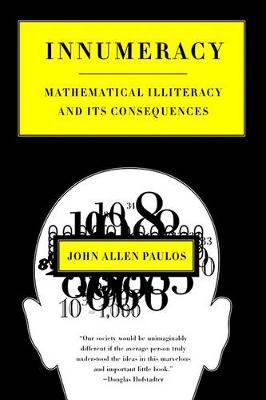
Readers of Innumeracy will be rewarded with scores of astonishing facts, a fistful of powerful ideas, and, most important, a clearer, more quantitative way of looking at their world.

Why do even well-educated people understand so little about mathematics? And what are the costs of our innumeracy? John Allen Paulos, in his celebrated bestseller first published in 1988, argues that our inability to deal rationally with very large numbers and the probabilities associated with them results in misinformed governmental policies, confused personal decisions, and an increased susceptibility to pseudoscience of all kinds. Innumeracy lets us know what we’re missing, and how we can do something about it.
Sprinkling his discussion of numbers and probabilities with quirky stories and anecdotes, Paulos ranges freely over many aspects of modern life, from contested elections to sports stats, from stock scams and newspaper psychics to diet and medical claims, sex discrimination, insurance, lotteries, and drug testing.